
On This Page
First, IdeaProof Itself, for Reference One Honest Thing First How I Scored Them The Ranking at a Glance The Alternatives, Ranked The Alternative None of These Research Reports Fully Replaces: Real Customers How to Actually Choose FAQs The Bottom LineIdeaProof does a lot in one workspace. An idea assessment, market research, competitor analysis, a business plan, branding and marketing assets. For a founder starting with a blank page, that breadth is useful. Calling it “just an AI score” would be a lazy comparison.
So why look elsewhere?
Usually because one part of the job still needs doing. You want to inspect the research behind the recommendation. You want someone to challenge your reasoning. You need actual customer feedback. Or you have enough analysis and need help deciding what to build, who to contact and what to do next.
Those are different reasons to switch. Another long report will not fix all of them.
Here are eight alternatives, ranked on six criteria, with the numbers in the open and real NELL output screenshots below.
First, IdeaProof Itself, for Reference
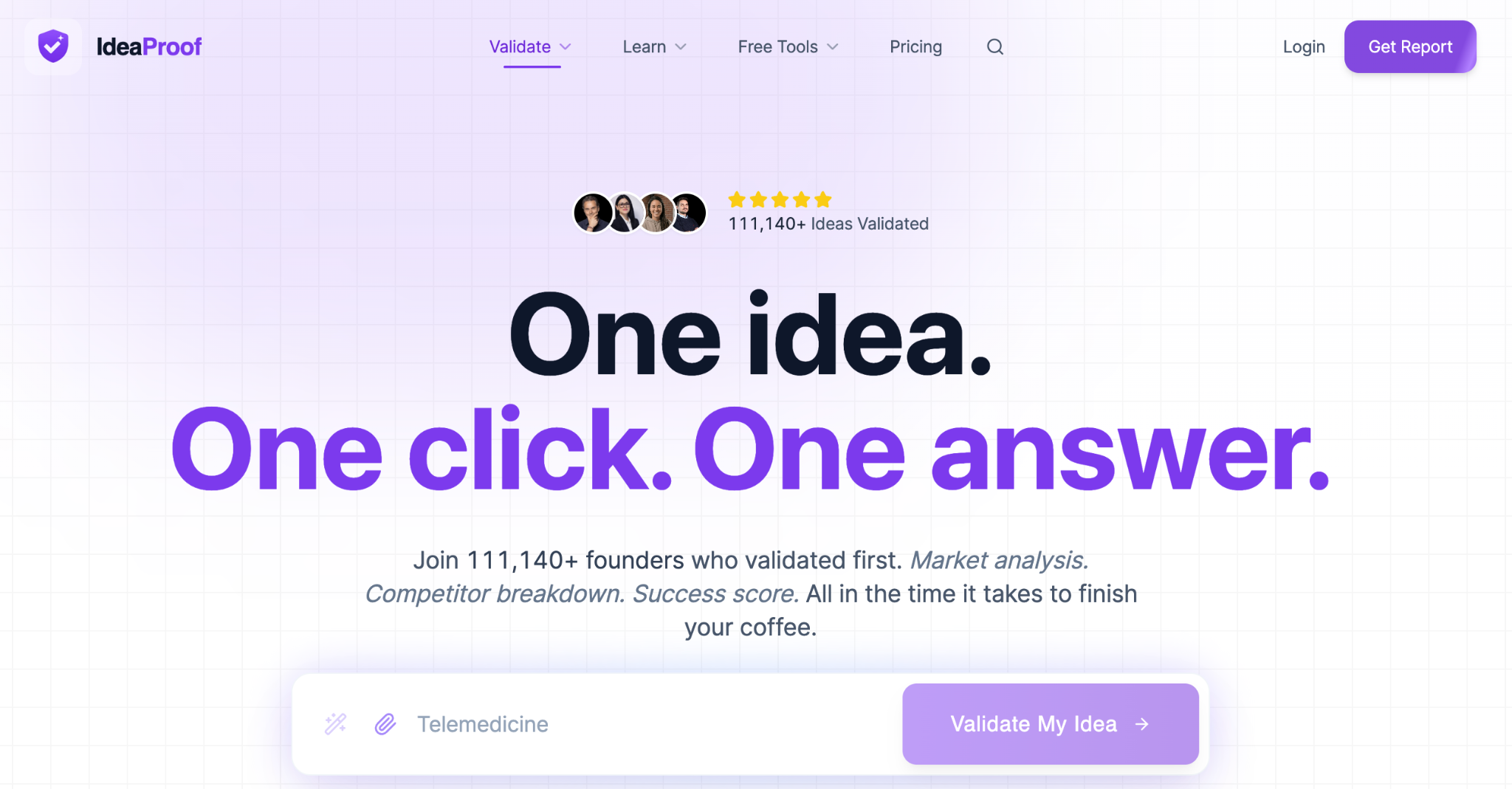
What it does well. Breadth and speed. Its workflow covers validation, market analysis, business planning and launch assets. That is a genuine advantage for someone who would otherwise assemble those outputs across several tools.
Pricing. Ninety free credits, no card. Paid access uses one-time Starter, Builder and Founder credit packs with 150, 700 and 1,500 credits respectively. We are not quoting a dollar price because the USD checkout amount could not be verified directly. A validation costs 40 credits; market analysis and business planning each consume more.
What users say. I would not claim a broad independent customer consensus from the review material available for this comparison. And I would not use a vendor’s advertised accuracy percentage as proof that its score predicts your business outcome. Judge the reasoning and the output, not the percentage on the homepage.
One Honest Thing First
This page is published by NELL, and NELL ranks first on it. You should be suspicious of that. Two points, straight.
One: IdeaProof may be the better fit when you specifically want validation, a business plan and brand assets in one workspace. Preuve is a serious alternative when the sourced research document is the main purchase.
Two: our rubric rewards depth and what you can do next. NELL’s combination of validation, product scope, GTM planning, outreach and operator support is why it comes out ahead under that rubric. It is not a claim that every founder needs the largest product.
What I can offer is the same scoring system applied openly, screenshots of the actual outputs and a straight answer about where another tool fits better.
Scoring Rubric
How I Scored Them
Six things that matter when you are deciding whether to build. Each scored from 1 to 5, equally weighted, for a total out of 30.
| Criterion | What I Am Looking For |
|---|---|
| Evidence and sourcing | Real, checkable support for important claims, rather than confident statements with no way to inspect them. |
| Depth | Market sizing, competitors, pricing, risks and economics, not just a surface-level score. |
| Rigor | Whether the tool challenges assumptions, acknowledges gaps and admits its limits. |
| Actionability | Concrete next steps, experiments, build priorities, outreach or leads. What can you actually do with the result? |
| Speed and ease | The friction between describing the idea and getting a useful answer. |
| Price and value | The free starting point and what useful depth costs. |
Usual caveats: this is not a controlled lab head-to-head, and the scores are not accuracy measurements or success probabilities. They show how the products compare under our editorial priorities. A narrower tool can still be the right purchase for a narrower job.
The Ranking at a Glance
Every criterion is out of five. Totals are out of 30. IdeaProof is the baseline, not one of the eight alternatives. User Intuition appears separately as the eighth option because an interview platform answers a different question.
Notice that most alternatives do not beat IdeaProof’s total. That is intentional. WorthBuild may be enough for inexpensive prospect discovery. IdeaBuddy may be better for financial planning. Neither needs to win every column to deserve a place here.
Also notice where NELL loses: speed and ease, 3 versus IdeaProof’s 5. The extra depth comes with more to work through. NELL’s five-point overall lead reflects higher scores elsewhere, not a clean sweep.
| Tool | Evidence | Depth | Rigor | Action | Speed | Value | Total |
|---|---|---|---|---|---|---|---|
| NELL Builder | 5 | 5 | 5 | 5 | 3 | 5 | 28 |
| Preuve AI | 5 | 4 | 4 | 4 | 4 | 5 | 26 |
| DimeADozen.AI | 4 | 5 | 4 | 4 | 3 | 3 | 23 |
| WorthBuild | 3 | 3 | 3 | 4 | 4 | 5 | 22 |
| VenturusAI | 2 | 3 | 3 | 3 | 5 | 4 | 20 |
| ValidatorAI | 2 | 3 | 2 | 3 | 5 | 4 | 19 |
| IdeaBuddy | 2 | 3 | 2 | 4 | 2 | 3 | 16 |
| IdeaProof (baseline) | 3 | 4 | 3 | 4 | 5 | 4 | 23 |
The Alternatives, Ranked
01NELL Builder by NELL AI Labs (28/30)
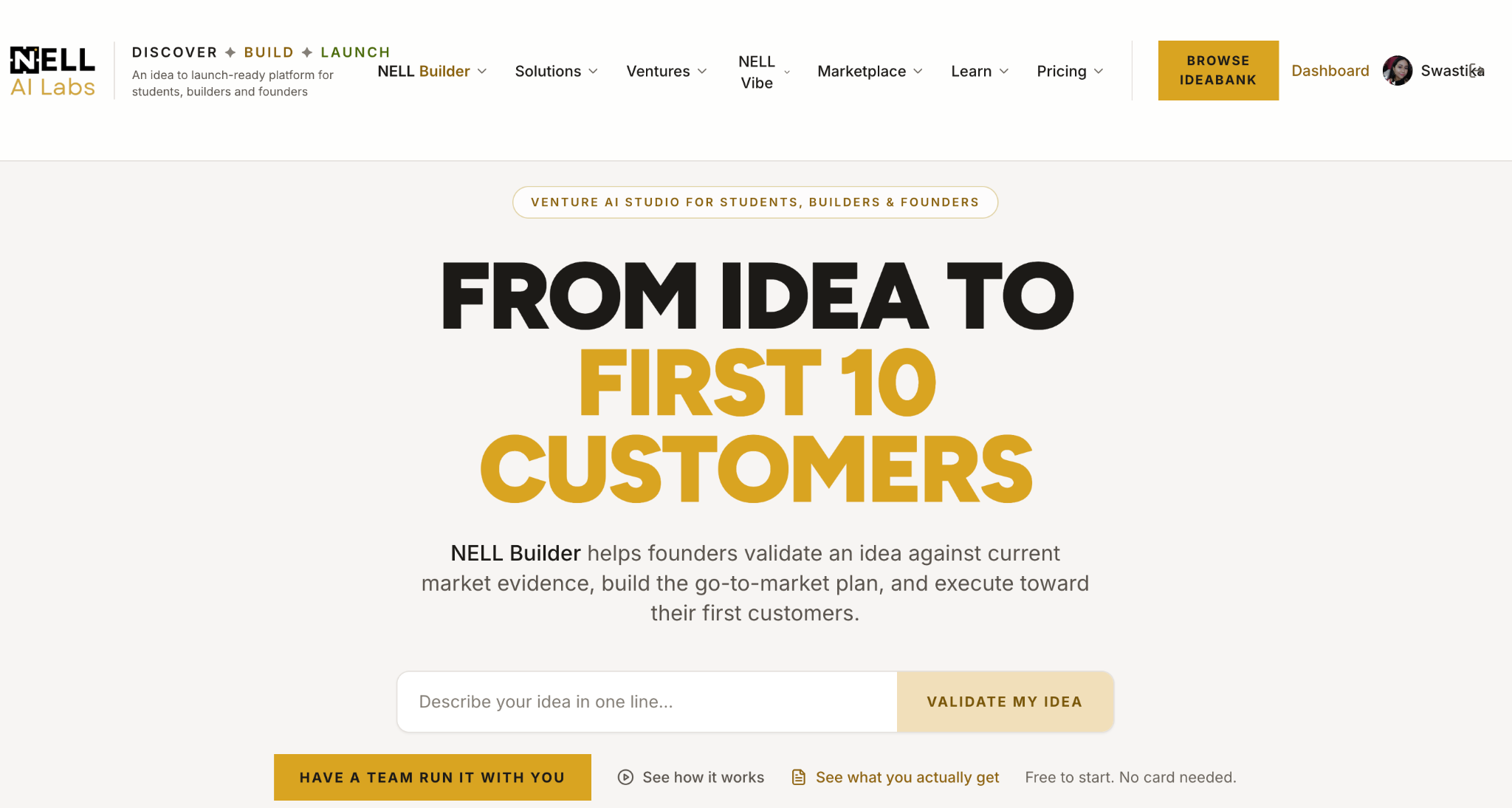
Start with what it actually is, because the category label undersells it. NELL Builder is an idea-to-launch engine. Validation is the first part you touch; the product continues into pricing, positioning, what to build and how to reach buyers.
Against IdeaProof, the distinction needs to be more specific than “we also produce a plan.” IdeaProof already does that. NELL’s case is the operating detail underneath: a sellable scope, named target accounts, buying roles, outreach, acquisition tests and playbooks you can run with operators.
Here is what that looks like in practice, tier by tier.
Free Tier
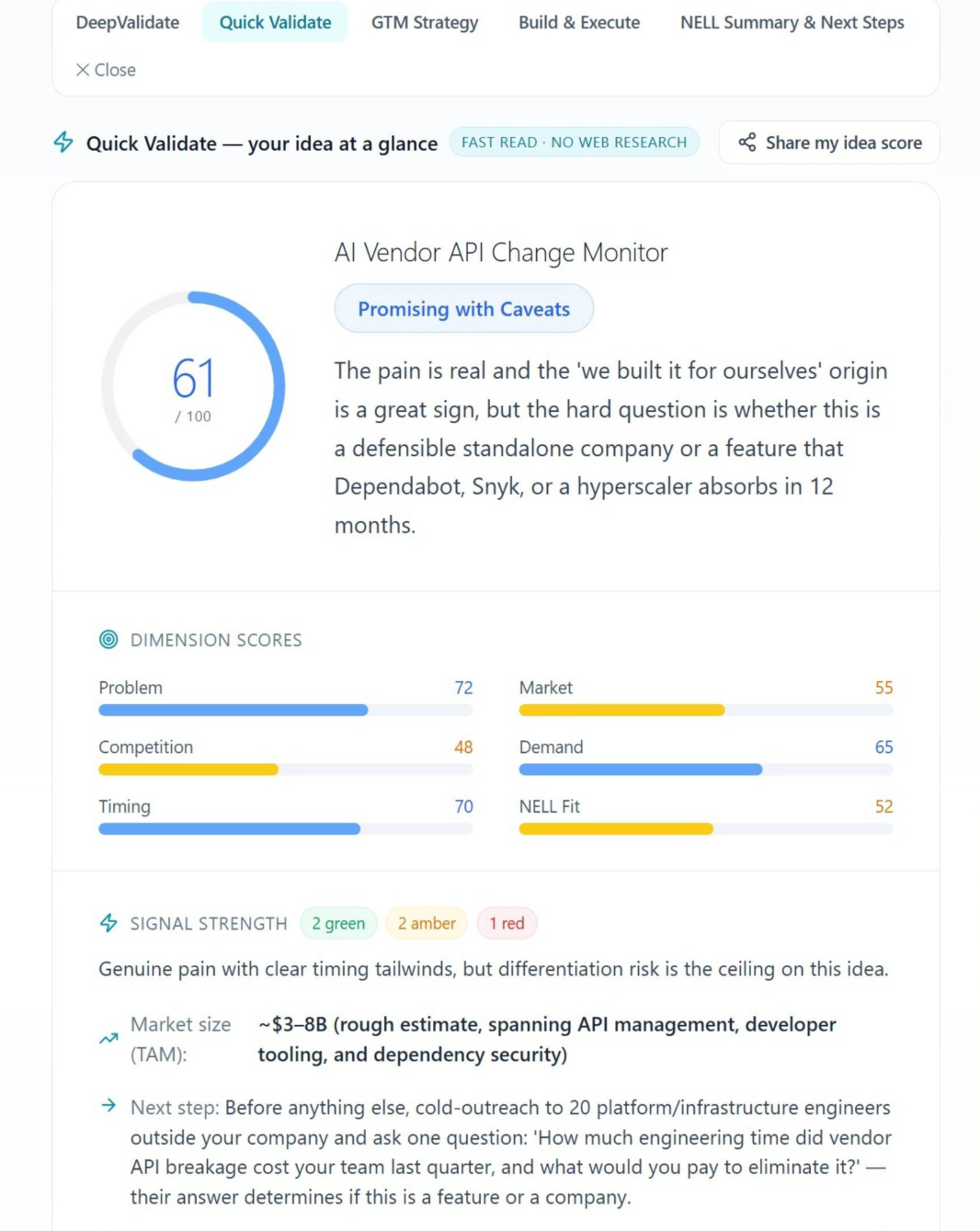
Quick Validate (Free): Your Idea at a Glance
Before you pay a cent, Quick Validate gives you a fast first read. A 0–100 score, a dimension-by-dimension breakdown, a green/amber/red signal read, a rough market estimate, the biggest unknown and a concrete next step.
This is not live web research. It is the initial assessment that helps you decide whether an idea deserves a deeper investigation. The sourced research comes next.
Deep Validation
DeepValidate ($49): The Same Read, Now Sourced and Deep
DeepValidate is where the live research starts. The current plan assesses 11 scored dimensions across five pillars, backed by market research, competitor analysis and an investor-ready PDF.
Here are the parts worth looking at, and what each is actually for.
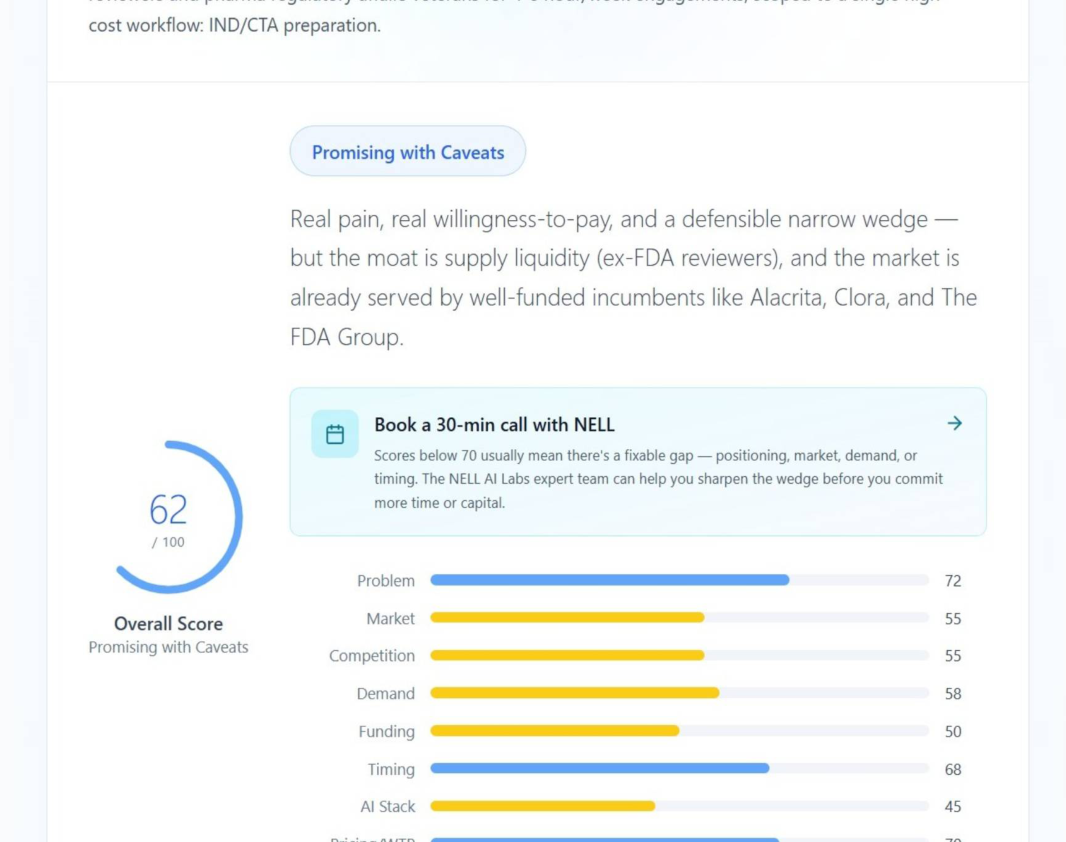
The verdict, scored and sourced. The report breaks the idea down across problem, market, competition, demand, funding, timing, the AI stack, pricing, economics and related commercial questions. You get the reasoning behind the score, including the uncomfortable parts.
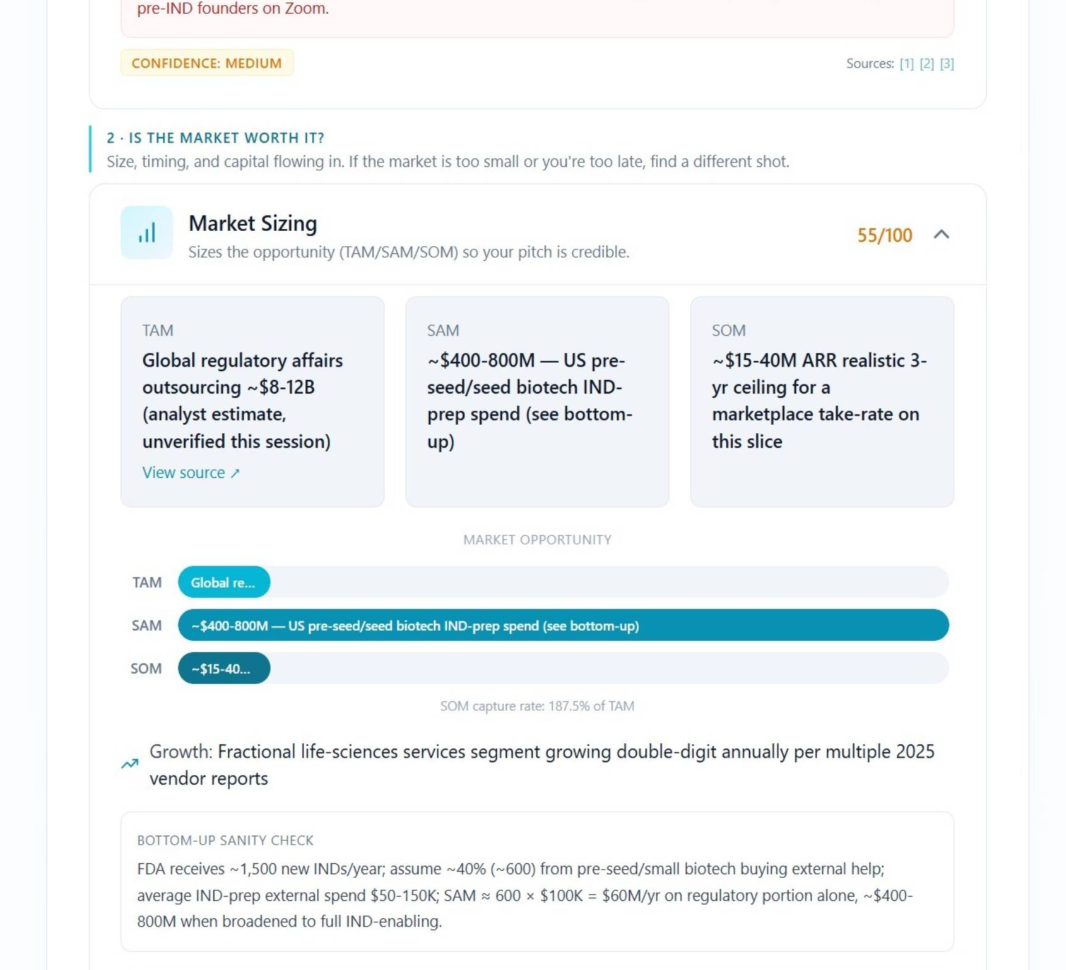
How big the market actually is. TAM, SAM and SOM, with sources and a bottom-up cross-check. The revenue ceiling makes the assumptions about customers, price and achievable reach visible. You get a market estimate you can examine, rather than a large number that falls apart when someone asks how you got there.
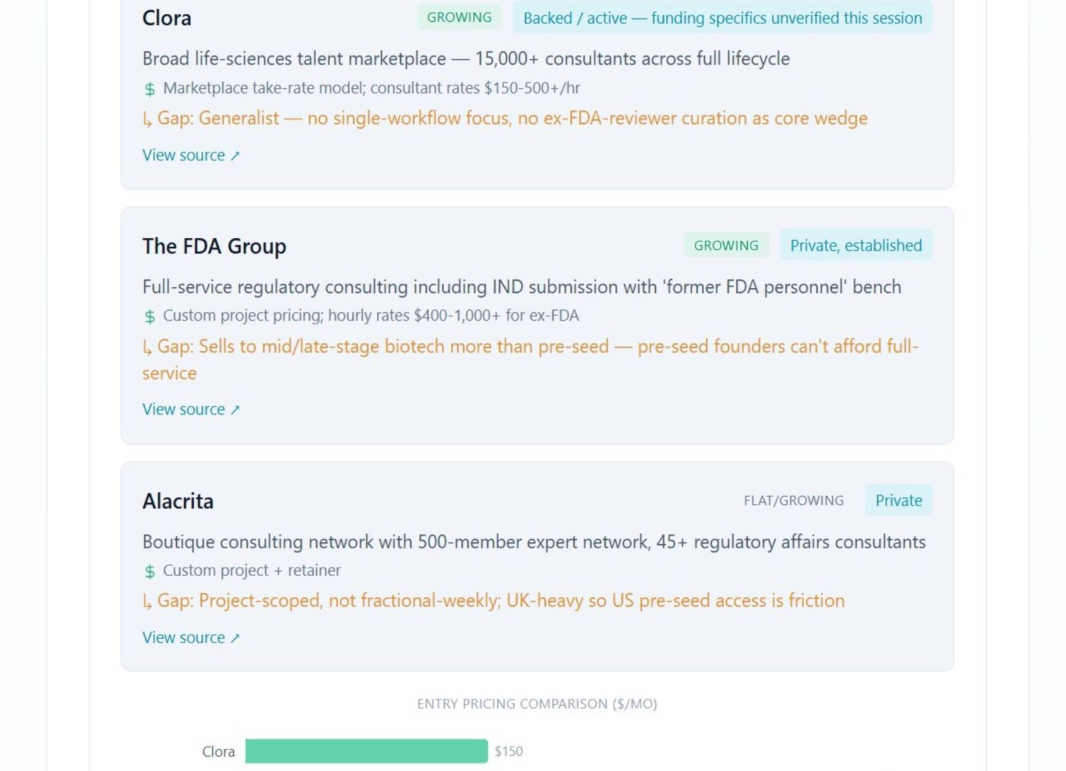
How crowded it is, and where you could compete. A named competitor comparison and a white-space map separate contested, emerging and potentially clearer opportunities. The useful output is a specific difference to investigate, not simply “there are competitors.”
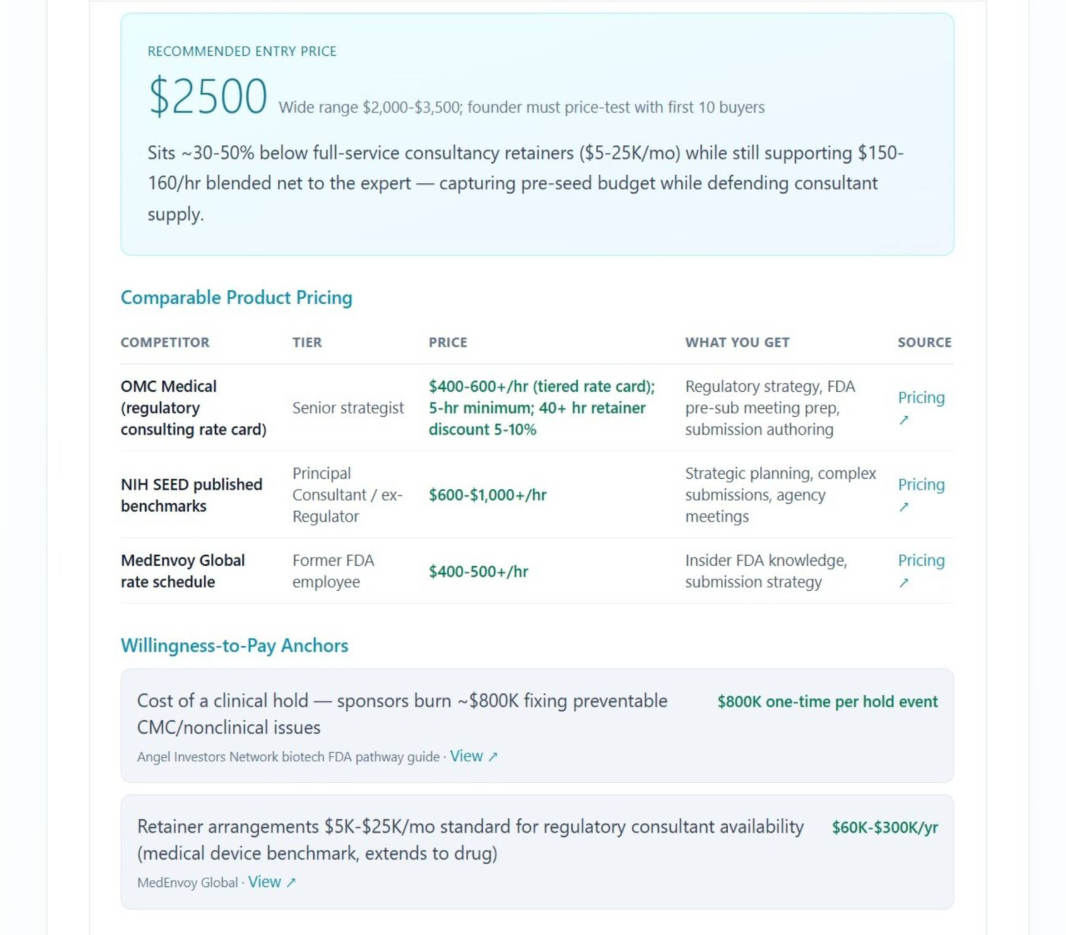
What to charge, and what backs the number. Comparable pricing, willingness-to-pay anchors, price-sensitivity signals and a recommended revenue model. These give you a starting price to test and the reasoning behind it. They do not mean customers have already agreed to buy your version.
The uncomfortable truths, in writing. Findings come with sources, confidence labels and gaps in the evidence. The “brutal truth” sections are there to keep the recommendation from becoming a collection of reasons to do what you already wanted to do.
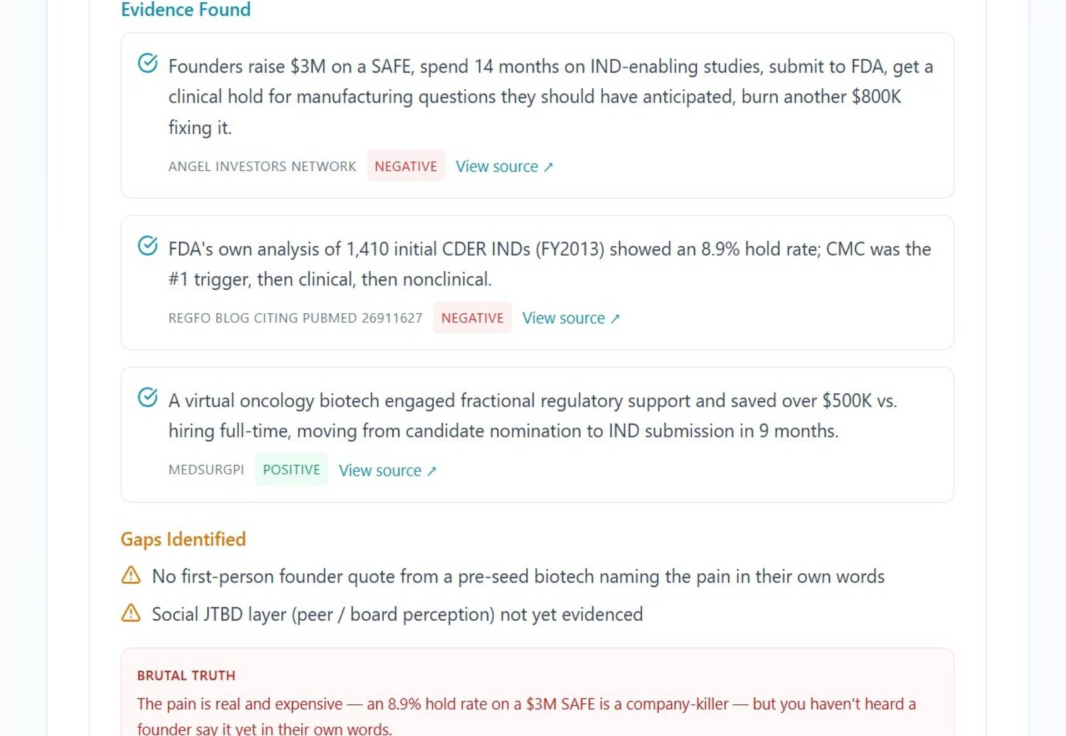
It also examines unit economics, including acquisition cost, lifetime value and payback; the proposed AI stack and technical risks; and regional market considerations. Those models and risk assessments help identify what to verify next. They are not substitutes for observed acquisition costs or customer retention.
Go-To-Market
Launchpad ($149): The Verdict Becomes a Plan
One level up, NELL carries the research into a full go-to-market strategy and build plan. This is where the output becomes much more useful to the founder who has decided to pursue a direction and now needs to act.
Your positioning, and the words to say. A one-line positioning statement and message variants built around a specific buyer. You get language to put on the page, in the pitch and in front of prospects, with versions to test instead of a blank document.
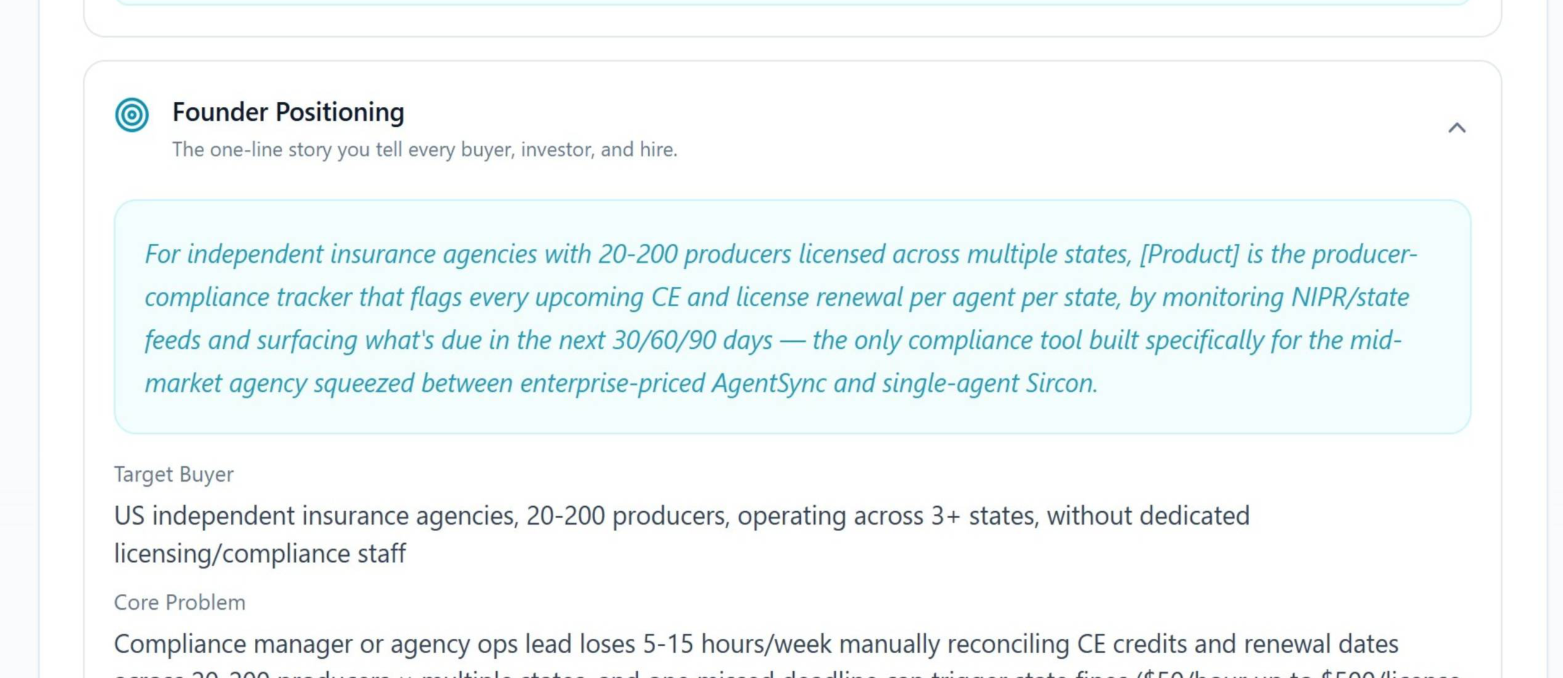
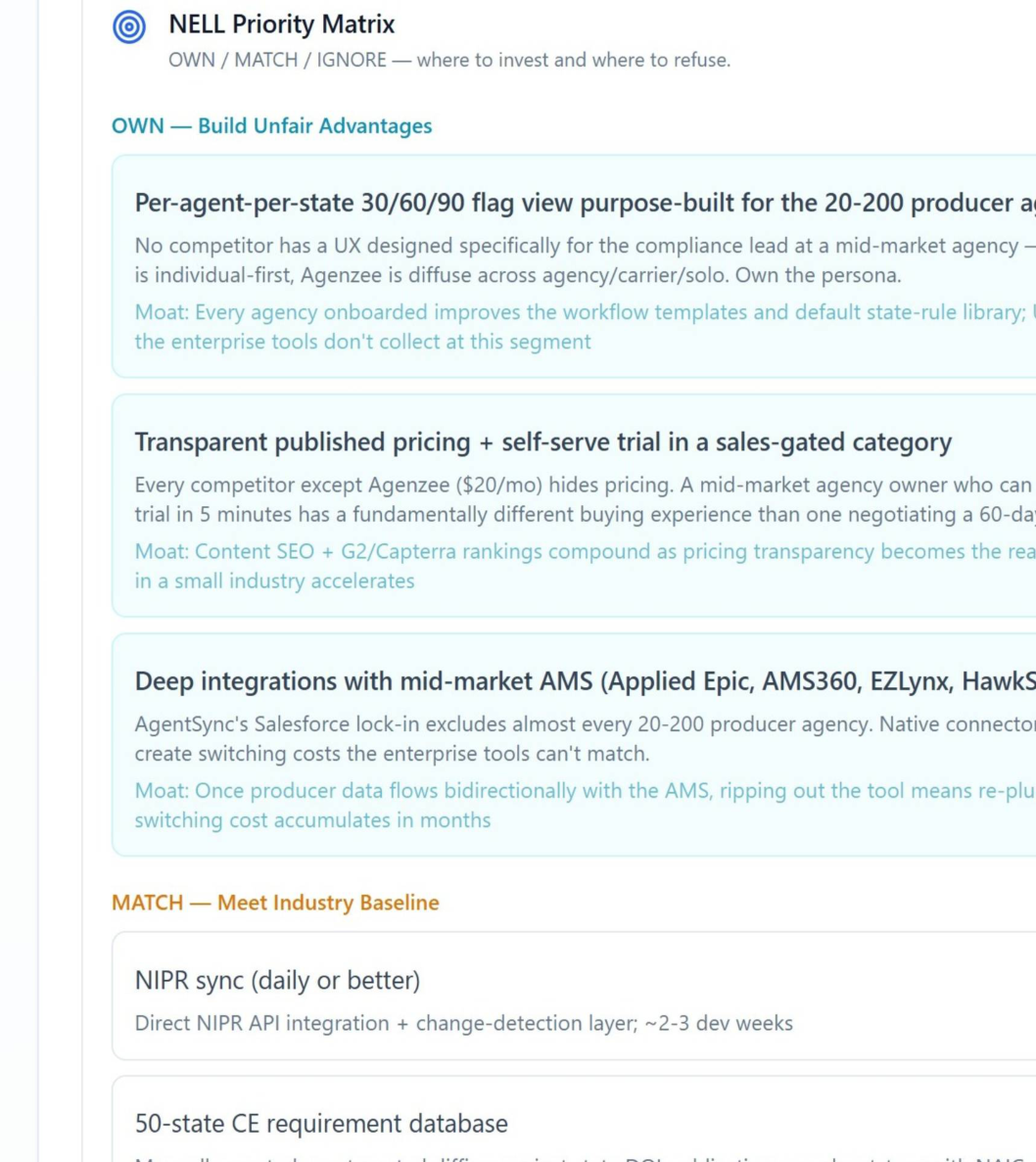
Where to invest, and where to refuse. The OWN / MATCH / IGNORE matrix separates where to build an advantage, where meeting the baseline is enough and where you should avoid spending. Useful when every possible feature starts sounding essential.
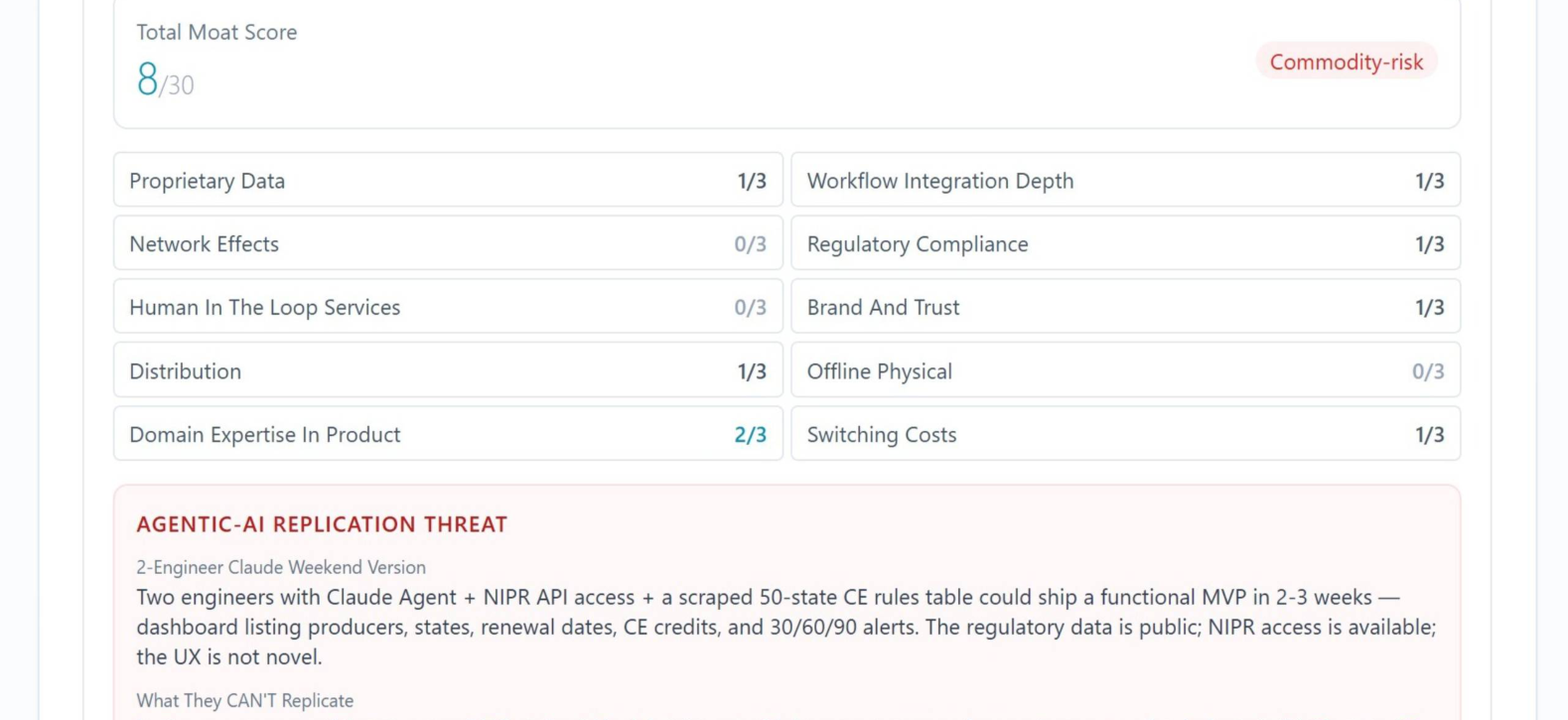
Whether your moat survives an AI clone. The defensibility audit scores the proposed advantage and stress-tests it against a lean team copying the visible product. What could they reproduce? What would remain difficult? The example is a scenario to examine, not a measured prediction of a competitor’s behaviour.
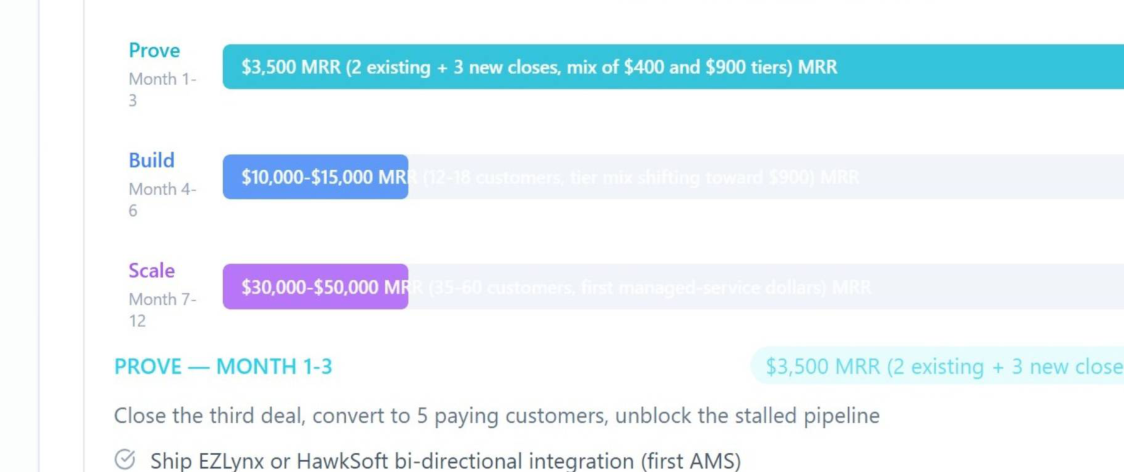
Your first ten customers, and a dated plan to reach them. A design-partner playbook, target accounts, introduction scripts, channel assumptions and a Prove–Build–Scale roadmap. You get work to do, owners and milestones, not “now go find customers.” The revenue figures in the example are targets, not results already achieved.
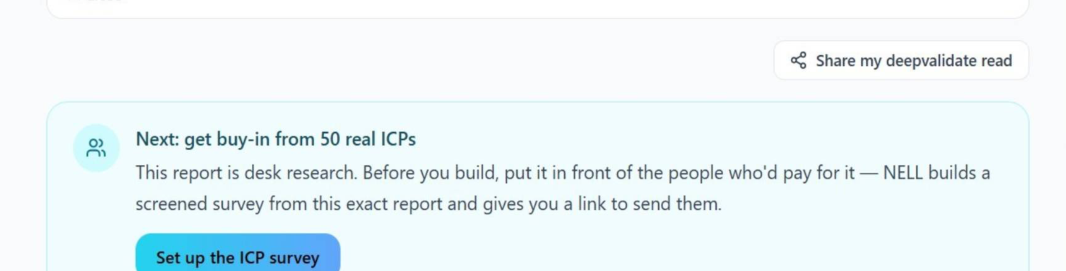
Real buyer feedback, alongside the research. Launchpad also includes the ICP buy-in survey. NELL writes it from your report, you share the link with potential customers, and screened responses feed into a go/kill assessment. This adds customer input to the desk research; it does not automatically replace interviews.
Launchpad also specifies the Minimum Sellable Product, with a clickable wireframe and build plan, and includes research into prior attempts at related ideas. It gives you named accounts, buying-committee information and outreach written for the relevant people. Thirty verified Apollo leads are included at this stage.
Execution
Pro Builder: Operators in the Trenches
The playbooks that run the launch, plus people to run them with. Pro Builder adds the deeper execution work: PMF validation, paid-channel testing, lead generation, outreach, sales and MRR execution, supported by operators.
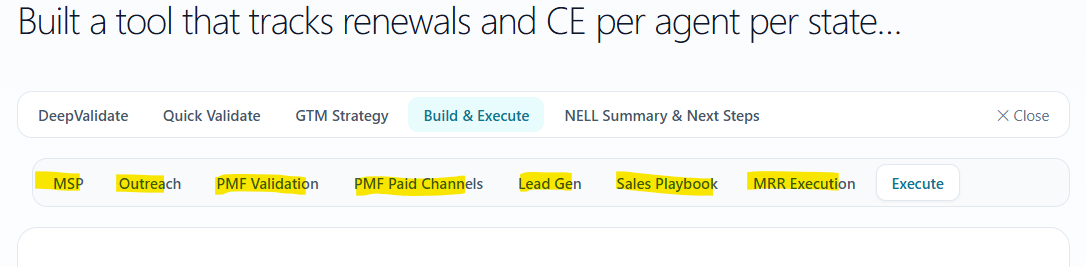
The point is to turn the plan into a working routine. What gets tested this week? Who needs contacting? What happens after someone replies? Which result means continue, change the approach or stop spending?
The current plan includes a 12-week operating runbook and MRR tracker, one-to-one operator support and weekly office hours. Scope is agreed with the team. You get help executing the work, not a promise that a revenue target will happen on schedule.
Plans
The Tiers at a Glance
These are the pay-as-you-go starting points where applicable; additional credits and recurring plans are separate options.
| Plan | What You Get | Starting Price |
|---|---|---|
| Quick Validate | A first assessment, dimension breakdown, biggest unknown and next step. No live web research. | Free |
| DeepValidate | Sourced commercial research, market sizing, competitors, pricing, economics, risks and a PDF report. | $49 for the first two reports, plus three IdeaBank briefs. |
| Launchpad | DeepValidate plus GTM strategy, buyer survey, prior-attempts research, product scope and outreach. | $149 for two validations, one GTM strategy and five briefs. |
| Pro Builder | Execution playbooks, an operating runbook and operator support. | Talk to the team about scope. |
Where IdeaProof still wins. Its integrated brand strategy, visual identity and marketing-asset generation can be the better fit when those are the outputs you need. Buying NELL’s operating depth solely to get a brand kit would make little sense.
Why NELL ranks first anyway. Under this rubric, the advantage is what happens after the research: a product scope, a GTM strategy, the messages and accounts to work, and operators to help run the motion. The trade-off is clear in the table. You get more depth and actionability, but more to work through.
Start with Quick Validate. Go deeper when the next decision calls for it.
02Preuve AI (26/30)
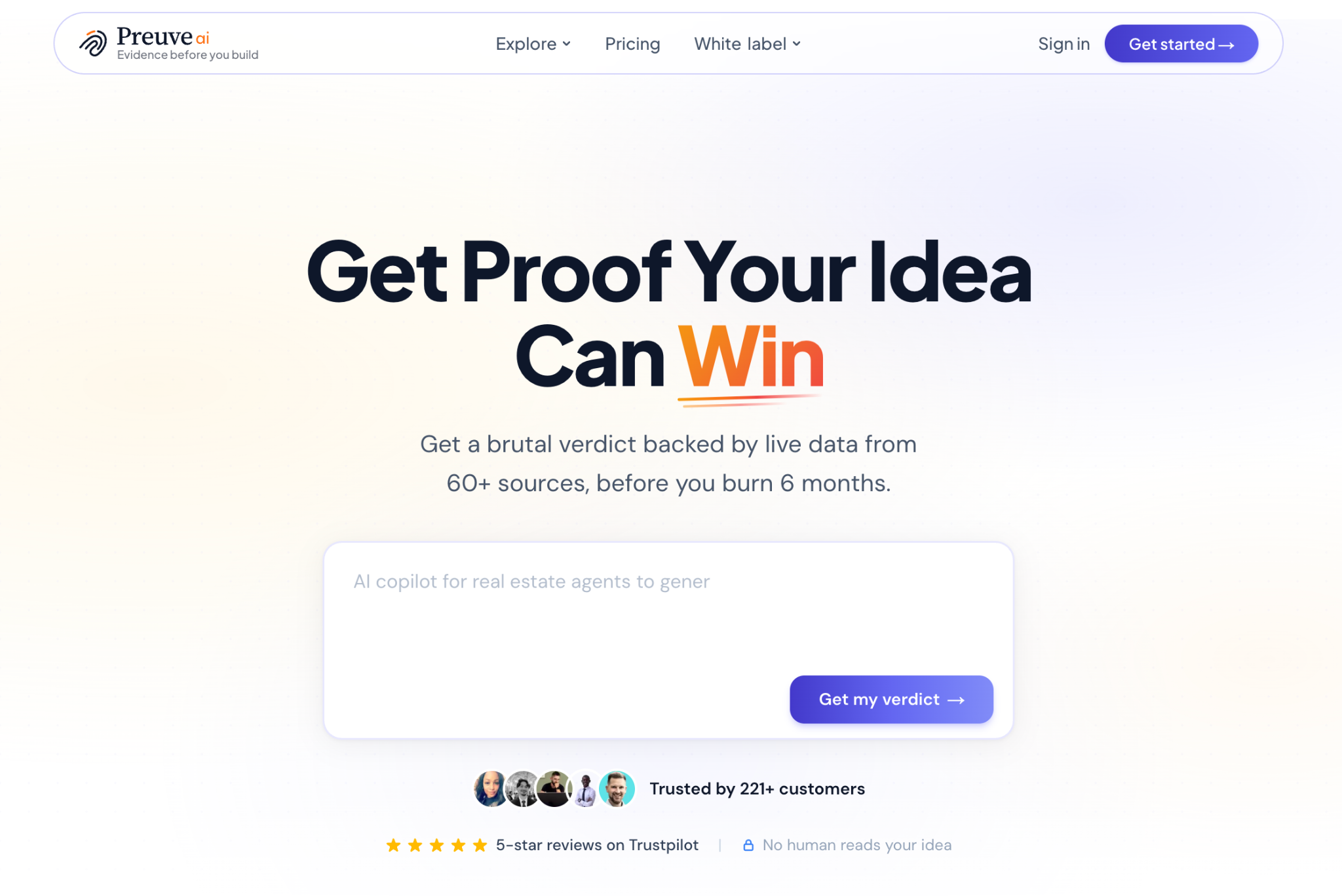
Why it’s here. One of the strongest research-first options in our comparison. Preuve centers the report on linked sources, market sizing, named competitors, demand evidence, risks and potential pivots. Its current offering also includes a business plan, GTM recommendations and ways to carry the report into action.
The limit. Sourced research is useful only when the interpretation fits your buyer. Cross-checking AI assessments does not turn them into customer commitments. Judge the important sources yourself.
Switch here when. The sourced assessment is the main job, and you prefer a research-first report over IdeaProof’s wider asset-generation workflow.
Pricing. One-time reports and multi-report packs, with regional offers. In India, the Starter Pro offer replaces the free Reality Check. The INR checkout amount could not be verified directly, so we are not quoting an exact rupee price.
What users say. The small Trustpilot review set includes praise for useful competitor findings and responsive support. Encouraging, but the linked research should do more of the persuading than a small star-rating sample.
03DimeADozen.AI (23/30)
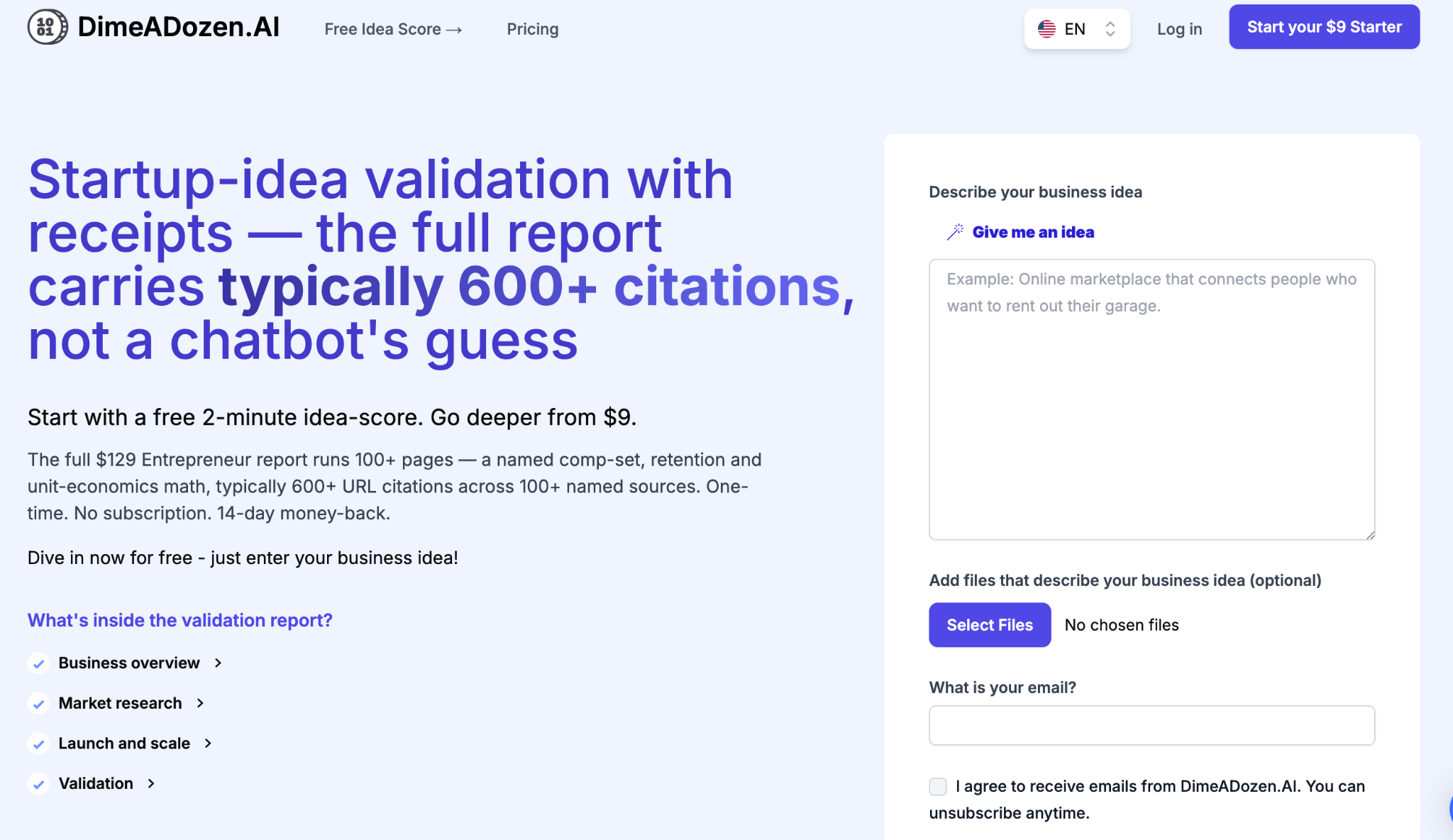
Why it’s here. The substantial decision-memo option. DimeADozen focuses on a long-form assessment covering competitors, market opportunity, economics, risks and execution requirements, with citation-backed research. It is a useful choice when you want a document to interrogate with a co-founder, rather than a fast yes/no signal.
The limit. Report-heavy. More pages and citations are not automatically more useful, and data about established companies cannot establish your startup’s future acquisition costs or retention.
Switch here when. You need a deeper pre-build document and are prepared to work through the assumptions behind it.
Pricing. A free four-dimension score, then $9 Starter, $129 Entrepreneur or $179 for three full reports. These are one-time purchases. The Starter report is a shorter entry product; it is not the full report for $9.
What users say. I would not claim a broad independent review consensus from the sources checked. The inspectable sample report is a better basis for deciding whether its depth earns the price.
04WorthBuild (22/30)
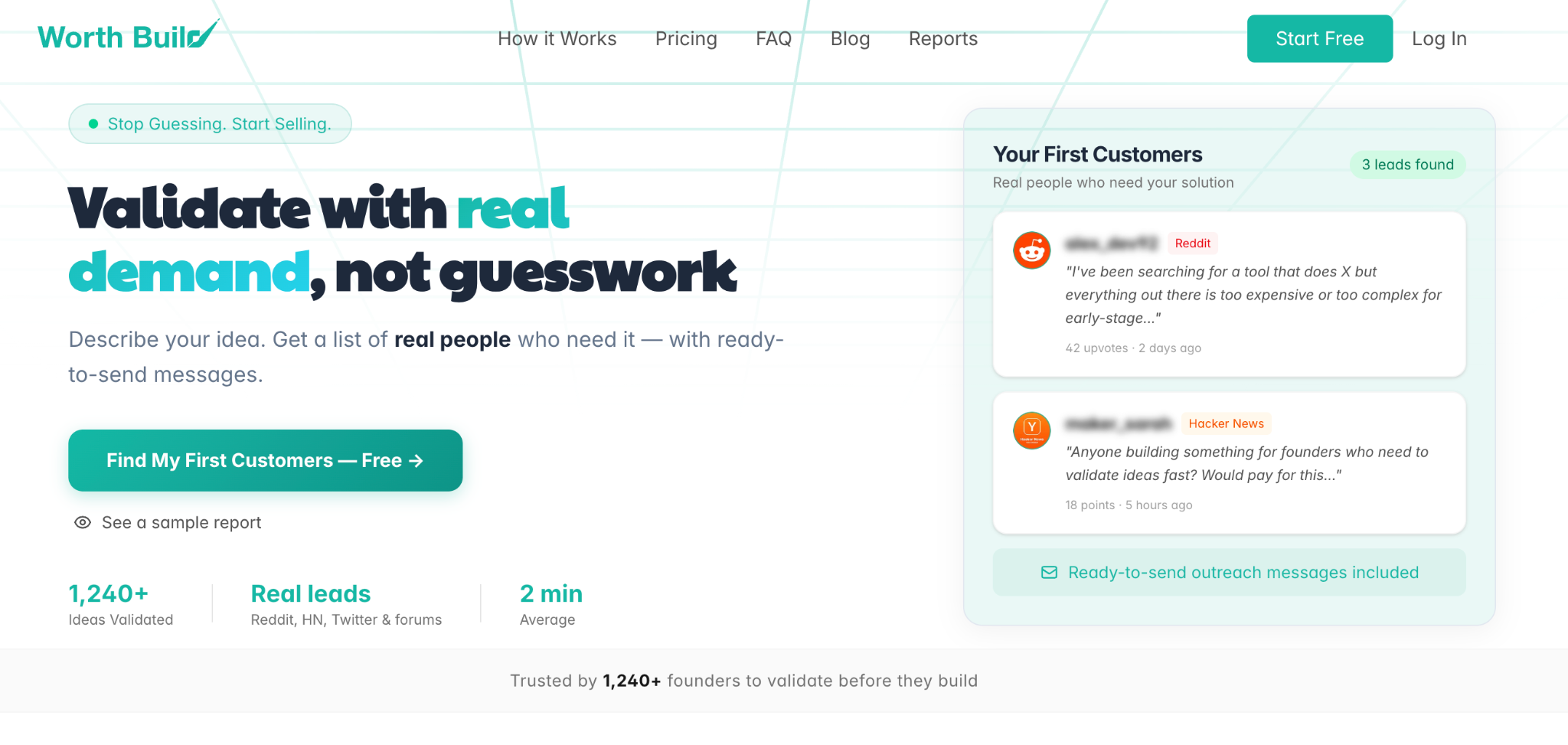
Why it’s here. Cheap research with a prospect-discovery angle. WorthBuild looks for relevant public discussions, identifies potential users and adds outreach suggestions. The package also includes market and competitor analysis and launch materials such as a waitlist page and pitch deck. The practical attraction is inexpensive first-pass research plus possible people to contact.
The limit. A person complaining online is not automatically a buyer. Check their role, whether the problem is current and whether the proposed outreach is appropriate. Prospect discovery still needs qualification.
Switch here when. You need an inexpensive first pass and possible customer conversations more than another set of brand assets.
Pricing. $5 for one report or $20 for five.
What users say. The site publishes positive testimonials about research and finding potential users. Those are vendor-selected. Treat them as early feedback and inspect the actual leads yourself.
05VenturusAI (20/30)
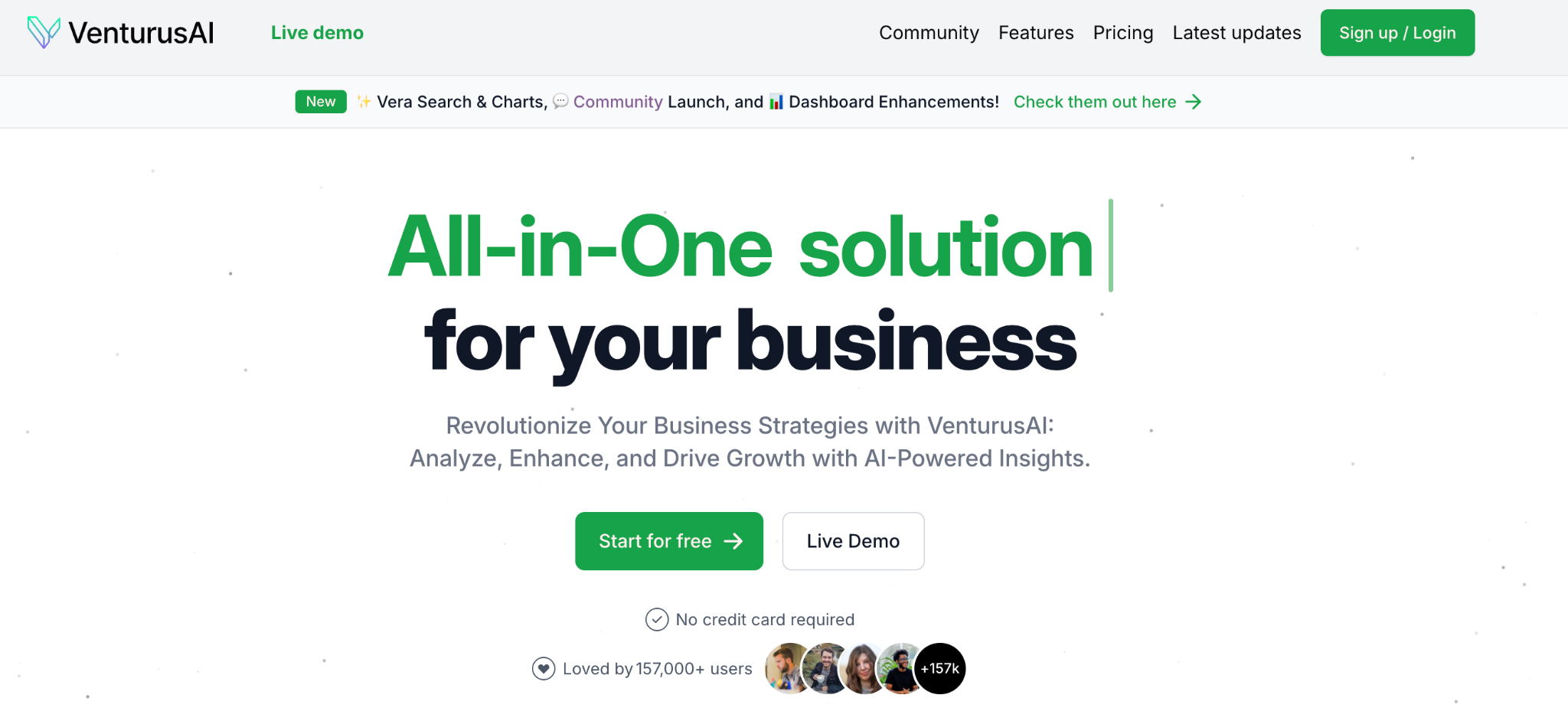
Why it’s here. A structured first look. VenturusAI organizes an idea through SWOT, PESTEL and Porter’s Five Forces, alongside audience, market and strategy analysis. It fits the founder whose notes need turning into a coherent starting document.
The limit. Completing a framework does not establish that its inputs are correct. Verify important market numbers and assumptions before treating the output as research you can rely on.
Switch here when. You need a low-friction, structured business assessment and are comfortable doing further verification yourself.
Pricing. Two standard reports a month free, with advanced reports available at $10 each on that plan. Paid plans are displayed from $10/month; billing terms and allowances differ.
What users say. The small G2 review set praises accessible, structured feedback. Some reviewers also mention slow loading or glitches. Useful first-pass feedback, not evidence that the recommendations predict business results.
06ValidatorAI (19/30)
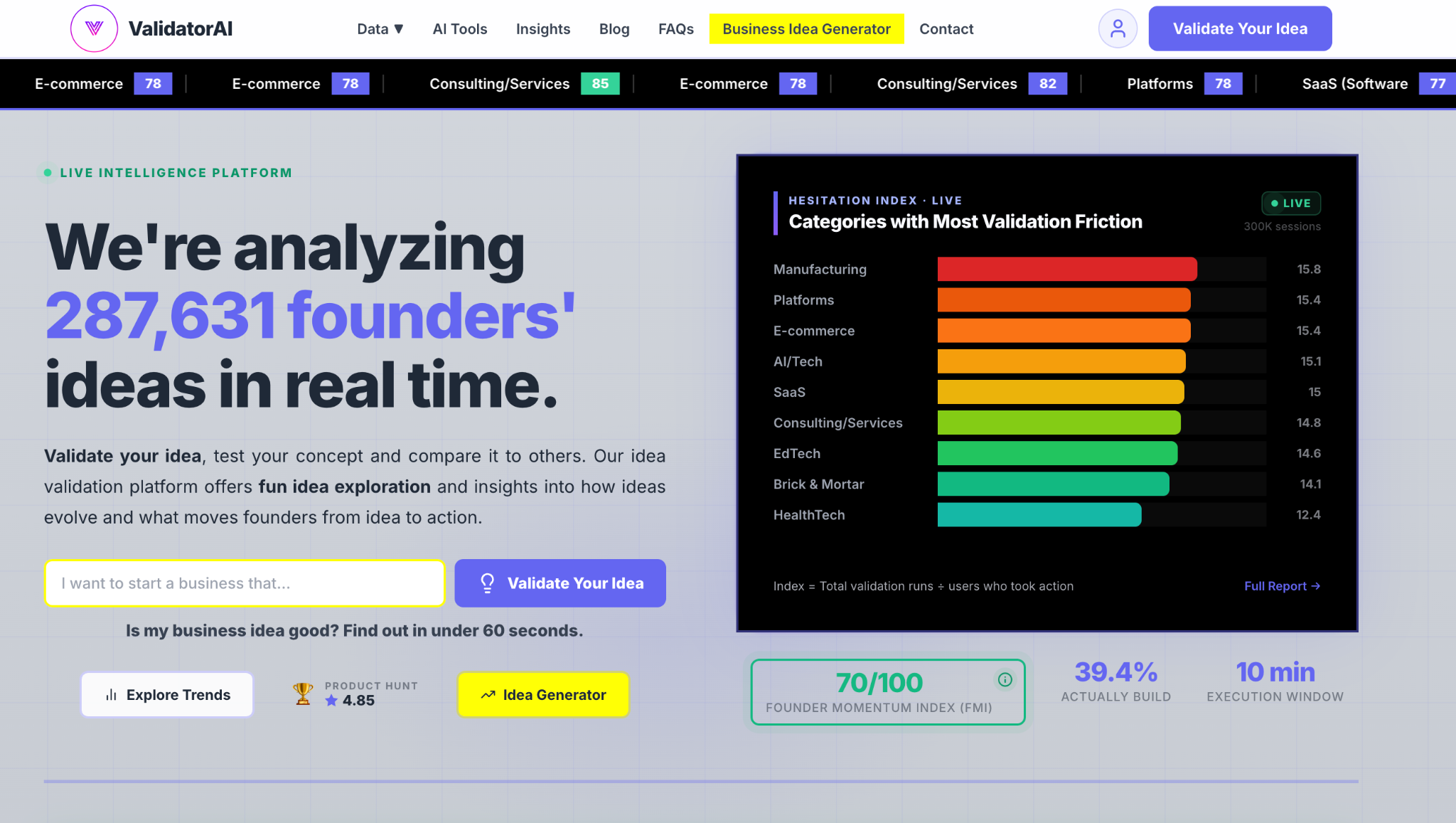
Why it’s here. The accessible starting point. ValidatorAI helps refine an idea and explore customer definition, assumptions, market sizing and GTM questions without paying for the core tools. Worth considering when IdeaProof’s broader workspace is more than you need at this stage.
The limit. Keep simulated feedback separate from customer evidence. An AI-generated customer response can help you prepare questions; it is not a person agreeing to use or buy the product.
Switch here when. You are still exploring directions and need a low-friction first conversation about the idea.
Pricing. We could not verify a dedicated public pricing page, so we are not quoting a paid-plan price or relying on third-party figures.
What users say. Accessible Product Hunt reviews praise the help organizing thoughts and refining ideas. That supports the early-stage use case. It does not establish that a positive assessment predicts demand.
07IdeaBuddy (16/30)
Why it’s here. The planning-first option. IdeaBuddy helps turn a concept into a business model, financial forecasts and a plan, with guided steps and collaboration. Its validation feature is attached to that planning work rather than being a substitute for external customer research.
The limit. A well-organized plan can still be built on bad assumptions. Ranked lower here because this rubric rewards research and validation, not because planning is unimportant.
Switch here when. The missing output is a business model and financial plan you can work on with collaborators.
Pricing. A 15-day free trial is available, followed by monthly or annual paid plans.
What users say. Its Capterra review base is more substantial than several smaller tools here. Reviewers praise the guided planning and approachable financials; criticisms include workflow and output limitations. Some reviews are marked incentivized.
The Alternative None of These Research Reports Fully Replaces: Real Customers
08User Intuition (a Different Category)

Why it’s here. Sometimes the next answer needs to come from a person. User Intuition runs AI-moderated interviews with human participants and organizes the recordings, transcripts, quotes and findings. You can bring your own audience or use recruitment options. For this comparison, the relevant feature is not “validation” in the abstract. It is a way to hear directly from the right people.
The limit. Respondent fit and the research question still matter. Interviewing the wrong people efficiently gives you the wrong evidence faster. And reported willingness to pay remains different from a purchase.
Switch here when. You know which audience you need to hear from and have questions that public market research cannot answer. It may belong alongside a research tool rather than replace one.
Pricing. $25 an interview with no annual contract; studies start at $200, and a 30-50 interview study runs about $750-$1,250. A pay-per-interview Starter plan is $0/mo; Pro is about $999/mo.
What users say. I would not repeat vendor-promoted satisfaction or rating figures as independently established results. Inspect a complete sample conversation and readout, then judge whether the interview probes beyond surface answers.
One important distinction: NELL’s Launchpad survey also brings in real buyer responses. User Intuition provides a dedicated interview process with follow-up questioning. Choose between those jobs, not between an inaccurate “AI versus humans” label.
How to Actually Choose
Don’t leave IdeaProof because a list told you to. Leave because something important is missing, and when nothing is missing, stay.
The score table shows the trade-offs. This table helps you choose the trade-off that matters to you.
| What You Want | Best Pick |
|---|---|
| If you need validation to become an operating plan, | NELL Builder — validation to execution. |
| If you need a research-first validation document, | Preuve AI |
| If you need a substantial pre-build decision memo, | DimeADozen.AI |
| If you need inexpensive research and potential people to contact, | WorthBuild |
| If you need a free, structured first look, | VenturusAI |
| If you are still exploring and need a free starting point, | ValidatorAI |
| If you mainly need a plan and financials, | IdeaBuddy |
| If you need to interview actual prospective customers, | User Intuition |
| If you need validation, planning and brand assets together, | IdeaProof |
FAQs
What Is the Best IdeaProof Alternative?
NELL ranks first under our six-criterion rubric because of its depth and actionability. That does not make it the right purchase for every job. Use the individual scores and the chooser above, rather than the total alone.
Why Do Some Alternatives Score Lower Than IdeaProof?
Because they are alternatives for specific needs. IdeaBuddy can be a useful planning choice without outperforming IdeaProof on sourcing. A cheaper, narrower product does not have to beat the baseline in every area to be worth considering.
Can an AI Validation Score Tell Me Whether Customers Will Buy?
No. It can help you investigate the case and identify what remains uncertain. Customer conversations, purchasing decisions and continued use supply different evidence. Use the report to make those tests more specific, not to avoid them.
The Bottom Line
IdeaProof’s breadth is useful. So is knowing when breadth is no longer what you need.
Buy the missing help: deeper research, a challenge to your reasoning, customer interviews, planning or execution. Another encouraging verdict is not much of an upgrade.
For the founder who needs the research carried into what to build and how to reach buyers, that is the work NELL is built around.
Start with free Quick Validate. Go deeper when the idea and the next decision deserve it.
Keep Reading